- Stroke of Confidence
- Posts
- 🎱 Speed Control 101
🎱 Speed Control 101
Speed control, your performance vs identity, and Chezka Centeno
Madison Gazda
September 18, 2025
Welcome back to Stroke of Confidence! Glad to have you here for another week.
Ever watch the pros and wonder how they always land perfect on the next ball? That’s not luck…that’s speed control. This issue we’ll dig into some tips to help improve your own speed control along with a gear review on a cool product that can specifically help you dial it in.
This week’s topics:
Speed control tips
Separating identity from performance
Chezka “The Flash” Centeno
Let’s dive in:


The Need For Speed…Control

Speed control is one of the sneaky skills that takes real intention and practice to master. If your cue ball’s always drifting too far or stopping short, this lesson is for you.
When you know how far the cue ball will travel after contact, you stop relying on guesswork and start building patterns you can trust. Most people try to fix their position play by obsessing over spin. And yes, spin matters. But if your speed is inconsistent, no amount of side spin is going to save you. Before you even get fancy with English, you need to develop a feel for how differences in your stroke tempo translates to distance. This is the foundation that all cue ball control is built on.
Here’s a list of tips to help you get started:
Visualize the shape – Don’t just think about making the shot. Think about where the cue ball needs to finish. This gives your stroke direction and intention.
Come into the line – If you send the cue ball into the natural line of your next shot, speed becomes less critical. Even if you come up a little short or go a little long, you’ll still land on a makeable angle.
Measure speed in table lengths – Try thinking of shot speed in terms of how many table lengths the cue ball travels. For example, a perfect lag is about two lengths. Training your feel this way gives you a clear, repeatable scale instead of saying “soft”, “medium”, “hard” or similar words that can mean different things to everyone.
Tip placement matters – Keep track of where you’re striking the cue ball. Practice shots using only high, center, or low tip positions so you can feel how each one affects the speed and distance.
Know the table – Fresh cloth runs fast. Older cloth grabs more. Cushions age over time and become harder. Even humidity levels change how the balls roll. Always take a few warm-up shots before a match to get a feel for the conditions.
Stroke tempo is crucial – A smooth backswing and steady follow-through give you natural control over distance. Think of your stroke like a metronome — even and repeatable. The calmer your tempo, the more predictable your cue ball becomes.
Miss smarter – Look at where you want to leave the cue ball and determine whether your position will still work if your cue ball rolls too far or if it rolls too short. For example, if you can miss short and still be ok, then you can err on the lighter side when you hit the cue ball.
Put in the time: Speed control isn’t something you just “get” overnight. It’s muscle memory. You need to put in the reps. Drills that isolate speed—like lag drills or stop shots at different distances—train your brain to connect feel with outcome. Tools like the ICA Training System can speed that process up big time.
This week’s video from FX Billiards breaks down a few key things to keep in mind including bridge length, table conditions, and how spin influences speed. There’s no shortcut here. Speed control is about repetition and awareness. Remember that anyone can hit a ball hard, but the real skill is hitting it soft and accurately.

Best tool for aiming & speed control: Cue Caddie
🎁 Use code STROKE35 for $35 off Cue Caddie Basic. Use code STROKE50 for $50 off Cue Caddie Pro.

Use code STROKE35 for $35 off Basic version. Use code STROKE50 for $50 off Pro version.
This is one of the most unique pool improvement tools available and blew my mind the first time I saw it in action. The Cue Caddie mounts right on your cue and gives real-time guidance while you practice. You train with your actual stroke so skills transfer straight to live play.
Why I like it:
On-cue mounting – Attaches to your cue with two removable O-rings. Secure hold, easy on and off, no damage to your cue. Weighs just over 1.1 oz, so it doesn’t throw off your feel.
Aiming made clear – Shows the exact cut angle and fractional-ball hit so you know precisely where to aim.
Pro version adds position play – Tell it where you want the cue ball to land and it suggests spin and speed to get there. Built-in position coaching on the next shot.
Builds real “feel” – Trains your pattern recognition so angles and routes start to pop out. The more correct reps you feed your brain, the faster your instincts sharpen.
Builds a pre-shot routine – Guides you through a repeatable pre-shot process that leads to less doubt and more consistency.
Everything included – Device, O-rings, USB-C cable for charging, and a quick-start guide so you can hit the ground running. No wifi needed except to download updates.
Downsides:
Learning curve – You still have to translate the guidance it gives into consistent mechanics. It’s not a magic wand that will solve your aiming and speed control instantly.
Price vs simple aids – Costs more than basic aiming tools…but that’s because it is the best tool out there for what it does.
If you want on-cue, real-time guidance that transfers straight to match play, Cue Caddie delivers.
👍️ Cue Caddie Basic – Aiming only. Shows where and how to hit the object ball. Best pick if you want a clean, lower-cost path to aim consistency. Use code STROKE35 for $35 off.
💪 Cue Caddie Pro – Everything in Basic plus position guidance. You specify the next position and it suggests spin and speed to get there. Ideal if you want integrated aim and cue-ball speed control. Use code STROKE50 for $50 off.
*Buying through this link helps support the newsletter at no extra cost to you.


Identity vs Performance

It happens to everyone. You lose a match you thought you should’ve won. You miss a few easy shots. You fall apart under pressure. And before you know it, you’re not just frustrated with your performance, you’re frustrated with yourself. You start thinking, maybe I’m not that good. Maybe I choke. Maybe I’m just not built for this.
That’s where the real damage happens. When you start confusing a single match with your identity, it chips away at your confidence. It’s not just about fixing a flaw in your stroke anymore, it feels like something is wrong with you.
But your performance is not your identity. It never was. Pool is full of highs and lows, good days and absolute disasters. The best players in the world have scratched on the 8-ball, missed straight-in shots, and blown huge leads. Arguably the best player in the world currently - Fedor Gorst - just got beat 9-0 recently in the Texas Open. What separates them is how they respond to those moments. They know it was just a bad day and they view it as a lesson. They step back, reset, and keep playing their game.
One bad match is not proof of failure. It’s just part of the process. The more you can detach from the outcome, the more free you’ll play. And when you're free, you're dangerous. Confidence doesn’t come from winning all the time. It comes from knowing that losing doesn’t change who you are.
So take a breath and stop making a single score feel like a summary of your story.

The Flash
Keeping with our theme of speed, Chezka Centeno is a natural player to highlight this week. Nicknamed The Flash, Chezka is one of the fastest players in the game and one of the most fun to watch. She’s a former World 10-Ball Champion and has the second highest Fargo rating of any women’s player in the world. Even though she can run multiple racks in the blink of an eye, her speed isn’t sloppy. Chezka stays calm, smooth, and deadly under pressure — a rare combo that makes her even scarier.
And if you need proof that fast can still be composed, check out the video below of her big recent comeback. Down big, but never rattled, she locks in and takes control one rack at a time. Blink and you’ll miss it.


🟢 2025 Predator WPA Men's 10-Ball World Championship - IN PROGRESS
Sept 17–28 | 10-Ball | Watch
Ho Chi Minh City Vietnam
🟢 Saigon International Women 9-Ball Open
Sept 20–25 | 9-Ball | Watch
Ho Chi Minh City Vietnam
🟢 PERI 9-BALL Open
Oct 02–05 | 9-Ball | Watch
Peri Pool Arena, Da Nang, Vietnam

🔎 Got a question about pool?
Submit it here
We’ll feature it in a future newsletter.
📖 Our favorite books on the mental game
🧰 Gear I Trust: What’s in my case
👤 Follow us on Facebook
📸 Follow us on Instagram
📰 Want to start a newsletter like this one?
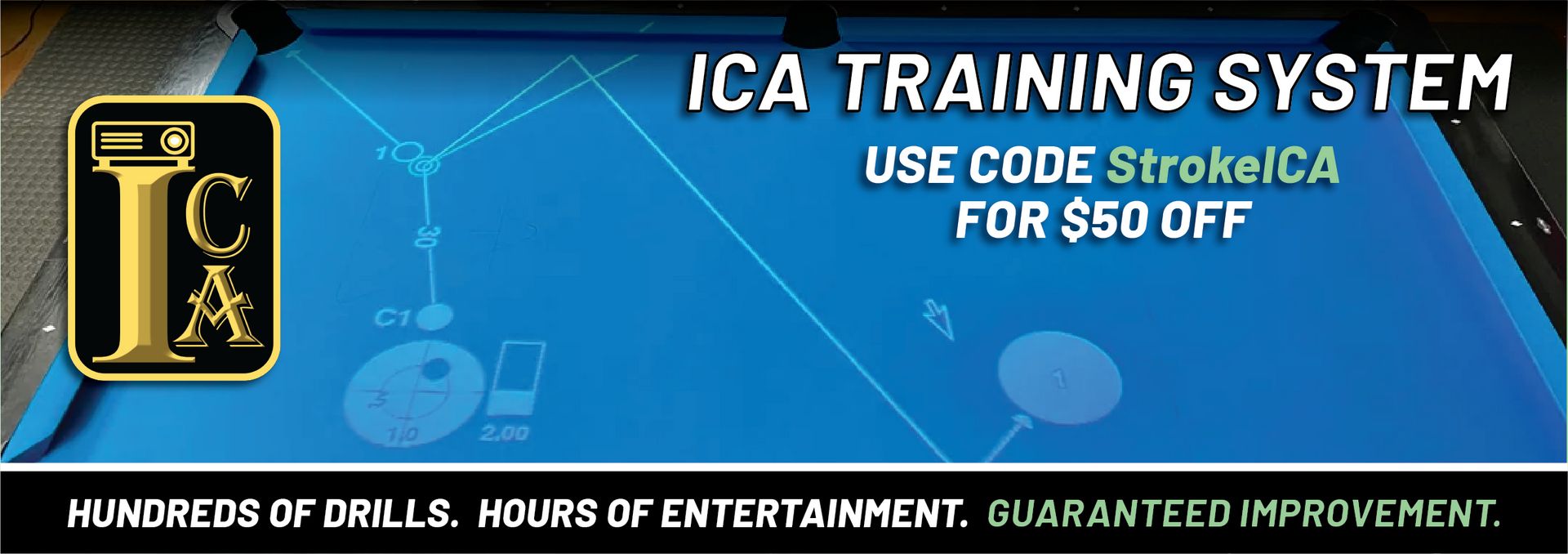
Use code StrokeICA for $50 off the ICA Training System without the projector.
That’s it for this week. Go hit some balls, dial in your speed, and see how much easier the game feels when the cue ball listens. See you again next Thursday.